


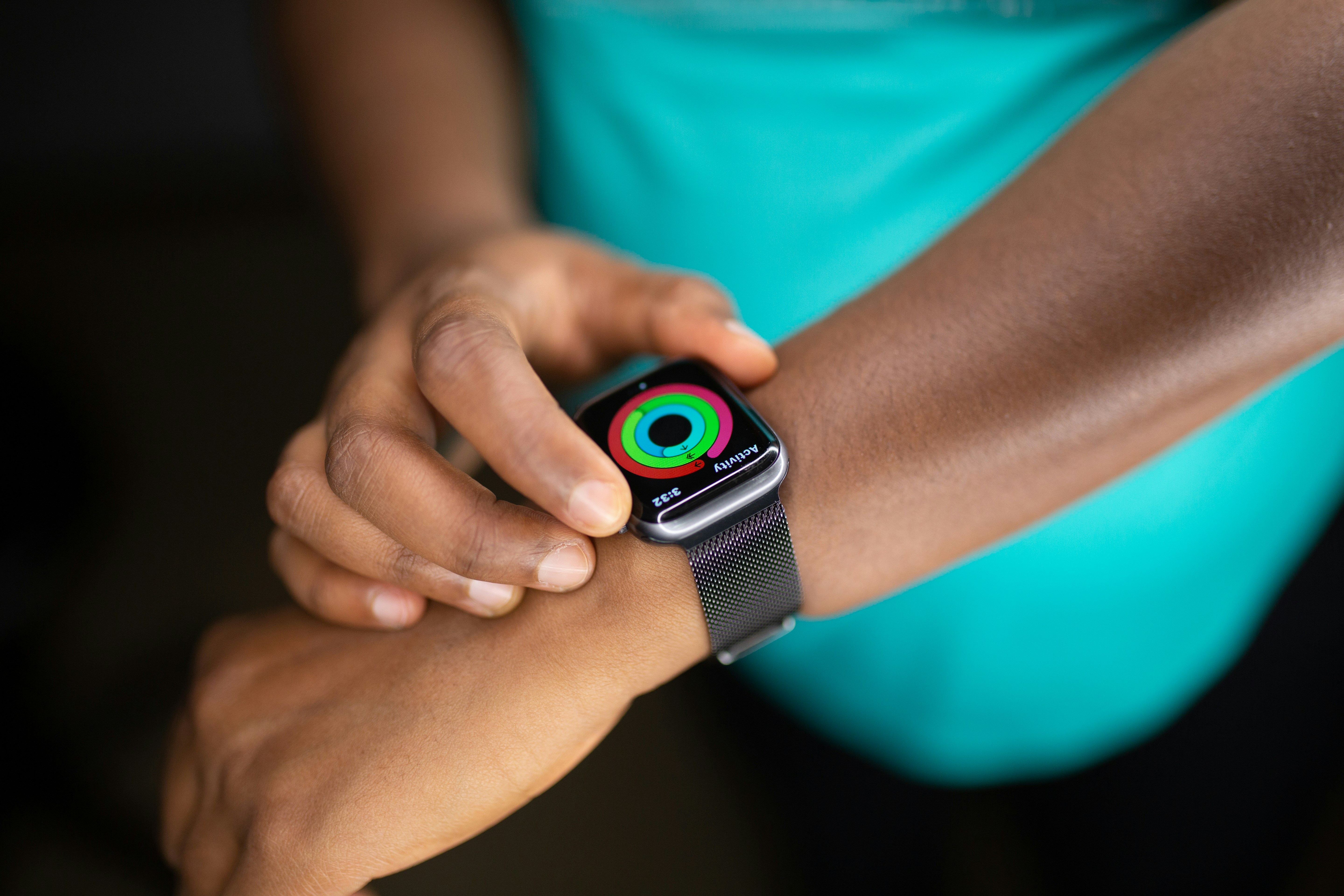
One of the traditional ways to improve your fitness and well-being is to hire a personal fitness trainer or a lifestyle coach. Taking this approach can help you learn how to exercise and make healthy choices. Alternatively, if you prefer to monitor your daily movement habits on your own, you could purchase an activity tracker.
As we all know, the rise of automation and technology has effectively affected the amount of movement in our lives. Many of us spend our days sitting. However, consistent movers already know that once you start moving you will feel better. The human body is designed to move. In the past, exercise prescriptions often left out the physical activity that we do just for the joy of moving. There has been a shift away from our traditional concept of intentional exercise activities to include movement habits beyond our historical concept – however, change is not always easy.

Photo by Joshua Miranda
What is Wearable Technology?
The American College of Sports Medicine (ACSM) named wearable technology the number one fitness trend in 2022. It’s fascinating that wearable technology has taken the top spot five times since it was introduced to the survey in 2016 (Thompson, 2022). Wearable technology, such as smart watches, heart rate monitors, and GPS trackers, can be used for many different purposes. These can track step count, heart rate, body temperature, calories used, and sitting time. New innovations in wearable technology include reliable and valid measures of blood pressure, oxygen saturation, respiratory rate, and even an electrocardiogram. Wearable technology can also be used in different modes to monitor other aspects of health and well-being beyond movement such as sleep time and quality.
Activity trackers in combination with apps are also effective at increasing daily physical activity (Laranjo et al. 2021). However, wearable activity tracker technology is changing rapidly and constantly. This makes it challenging to find up-to-date evidence-based research. The accuracy of these devices may also vary widely. Despite these issues, wearable technology is estimated to be a $100 billion industry.
Activity Trackers as an Alternative to Fitness Centres
As Michelle Segar describes in her book The Joy Choice (2022), many clients don’t realize that moving throughout the day counts toward health and fitness, believing they can only get fit by joining a gym. In most cases, barriers to using formal fitness programs and facilities are costs, discomfort with equipment, or difficulty attending classes at a specific time or day. Activity trackers tend to reduce or overcome these barriers in some cases. Many people also find using an activity tracker less intimidating than joining a fitness facility. These devices can offer objective accountability as well as social connections with apps.
The COVID-19 pandemic has also provided many individuals with the incentive and opportunity to consider usingactivity trackers as an alternative to their fitness routine in a facility. The pandemic resulted in over 17% of fitness facilities in the United States closing—and as high as 40 to 50% in other countries. Many people turned to activity trackers as an alternative for accountability and connection.

Photo by Ketut Subiyanto
Activity Trackers in Combination With Coaching
Activity trackers can assist you with behaviour change by helping you set more realistic movement goals that are specific to the demands of your own life. They can also prompt you to move more and sit less, and record your movement in a very easy way. Research suggests that using a wearable activity tracker as either the primary component of an intervention or as part of a broader physical activity intervention has the potential to increase physical activity participation (Brickwood et al. 2019). Coaches have also been found to have more success working with clients who use activity trackers after both parties have acquired personal experience using the devices (Kiessling and Kennedy-Armbruster, 2016). Physical activity interventions are often short-term. The inclusion of an activity tracker may provide an effective tool to assist health professionals in providing ongoing monitoring and support.
References
- Thompson, W.R. 2022. “Worldwide Survey of Fitness Trends for 2022.” ACSM’s Health & Fitness Journal 26 (1): 1-20.
- Laranjo, L., Ding, D., Heleno, B., B. Kocaballi, J.C. Quiroz, H.L. Tong, B. Chahwan, et al. 2021. “Do Smartphone Applications and Activity Trackers Increase Physical Activity in Adults? Systematic Review, Meta-Analysis and Metaregression.” British Journal of Sports Medicine 55: 422-432.
- Segar, M. 2022. The Joy Choice: How to Finally Achieve Lasting Changes in Eating and Exercise. New York: Hachette Book Group.
- Brickwood, K.J., G. Watson, J. O’Brien, and A.D. Williams. 2019. “Consumer-Based Wearable Activity Trackers Increase Physical Activity Participation: Systematic Review and Meta-Analysis.” JMIR mHealth and uHealth 7 (4): e11819. https://doi.org/10.2196/11819.
- Kiessling, P., and Kennedy-Armbruster, C. 2016. “Move More, Sit Less, Be Well. Behavioral Aspects of Activity Trackers.” ACSM Health and Fitness Journal 20 (6): 26-31.
Header photo by Solen Feyissa

Adapted from:
Fitness and Well-Being for Life
Carol K. Armbruster, Ellen M. Evans and Catherine M. Laughlin