


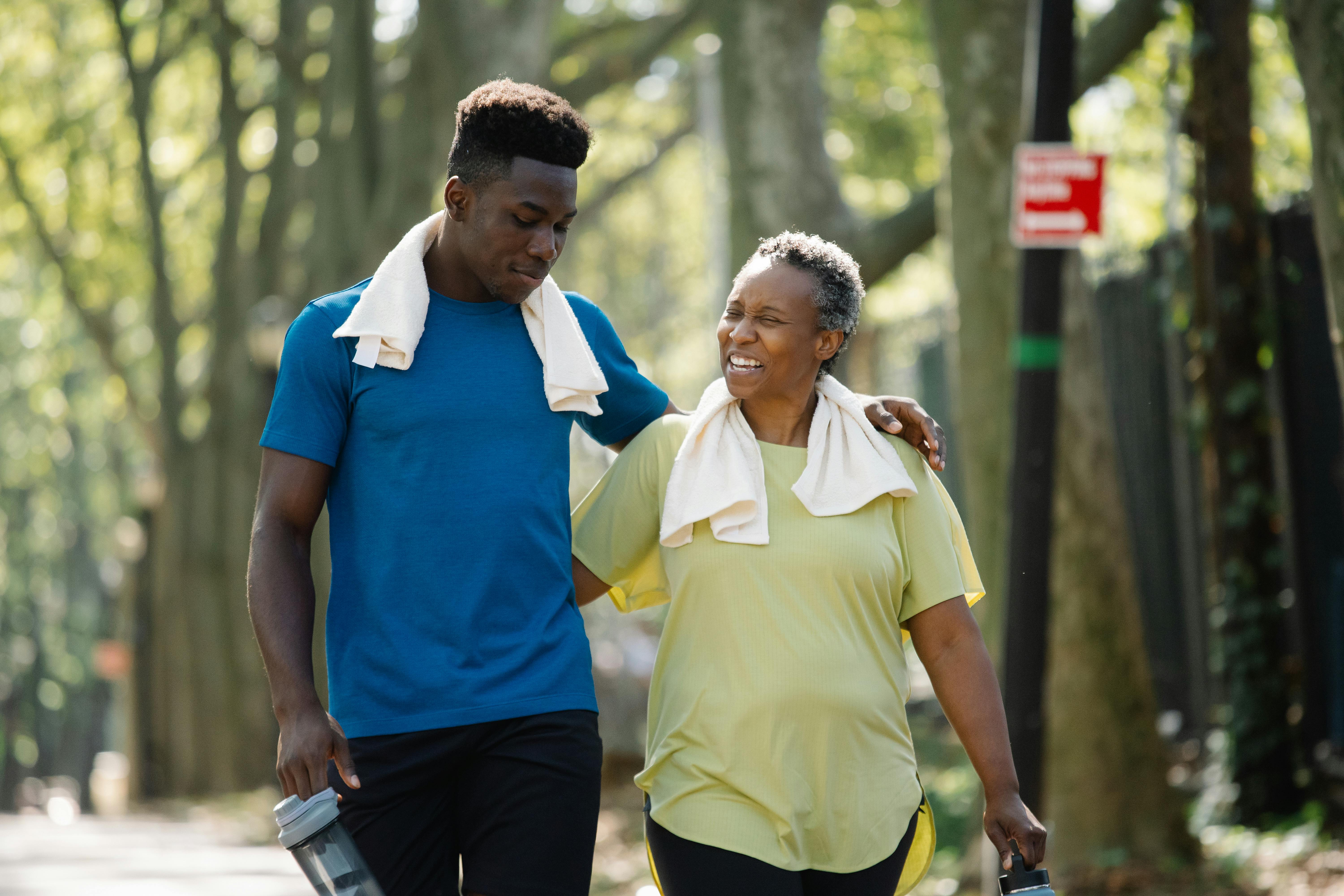
In recent years, so much attention has been brought to the benefits of walking on a regular basis for your health. However, we often overlook the powerful benefits walking can have on your mind, your mood, and even your relationships.
Walking can provide people with many non-physical benefits, which can show up immediately – from just one walk – while many physical benefits may take weeks, months, or even years to become evident.
Disease Risk Reduction
Type 2 diabetes, Alzheimer’s, dementia, cardiovascular disease, depression, obesity, cancer. Walking has been shown to be an effective tool to reduce the risk of these and other chronic diseases, including some types of cancer. A study from 2016 found that leisure-time physical activity, like walking, is associated with lower cancer risks (1).
Injury Rehabilitation
Whether it’s back pain, a knee injury, or recovery from surgery or various tendinopathies, walking can play a key role in bridging the gap from injury to a return to sport and life. Walking provides that time on our feet that allows us to continue grooving the linear pathways of ambulatory movement. It helps to reinforce the pattern of walking, hiking, jogging, running, rucking, and snowshoeing. As health practitioners who work with injured runners, walking is the primary modality to help improve overall threshold and tissue tolerance while we strengthen, address underlying issues, and allow sufficient tools and strategies for recovery. It buys us time while we rehabilitate, strengthen, stabilize, mobilize, realign, and make necessary corrections. Walking can be that first step to get individuals back to doing what they love.
Cardiovascular Health
Walking can be a moderate-intensity cardiovascular activity that helps to protect our hearts and reduces the risk of cardiovascular disease. Older adults who take more daily steps decrease their risk of cardiovascular disease (2). The meta-analysis by Sheng et al. (3) found that higher step count equated to lower risk of cardiovascular events and premature death, even with total step counts less than 10,000 steps per day. Another study found that brisk walking and vigorous exercise are associated with reduced coronary events among women (4). Walking is a good form of cardiovascular activity. Truthfully, although the studies are robust and contain large sample sizes, it is possible to obtain similar benefits from other activities. Many of the studies included individuals who were sedentary, and because of their inactivity, any exercise plan may possibly have created similar results. Although there are many forms of physical activity to choose from, walking is one of the most convenient, low-risk, comfortable, cost-effective, and simple forms of physical activity out there. For someone just beginning, it’s an easy starting point to create a good foundation.
Immune Boosting
In general, exercise boosts overall immunity. “Regular, moderate to vigorous physical activity is associated with reduced risk of community-acquired infectious diseases and infectious disease mortality, enhances the first line of defence of the immune system, and increases the potency of vaccination,” according to a systematic review by Chastin et al. (5). The lymphatic system, which essentially is part of our immune system, contains cells that help to ward off infection and diseases. Exercise, including walking, helps boost its overall function.
Brain Boosting
Walking has been proven to boost creative thinking (6). Another study found those who took more than 4,000 steps per day had healthier brain tissue in the area responsible for memory, learning, and cognitive function (7). Taking advantage of those post walk boosts of creativity might be helpful in planning specific tasks. We often feel refreshed, invigorated, energized, and mentally sharp after walking or most forms of physical activity. If there’s flexibility in your day, consider shifting certain work tasks to occur after walking. Or if you’re finding it difficult to get through certain work or school projects, taking a short walk may give you a fresh outlook.
References
- Moore SC, Lee IM, Weiderpass E, Campbell PT, Sampson JN, Kitahara CM, Keadle SK, Arem H, Berrington de Gonzalez A, Hartge P, Adami HO, Blair CK, Borch KB, Boyd E, Check DP, Fournier A, Freedman ND, Gunter M, Johannson M, Khaw KT, Linet MS, Orsini N, Park Y, Riboli E, Robien K, Schairer C, Sesso H, Spriggs M, Van Dusen R, Wolk A, Matthews CE, and Patel AV. Association of Leisure-Time Physical Activity With Risk of 26 Types of Cancer in 1.44 Million Adults. JAMA Intern Med. 2016 Jun 1;176(6):816-25. https://doi.org/10.1001/jamainternmed.2016.1548. PMID: 27183032; PMCID: PMC5812009.
- Paluch AE, Bajpai S, Ballin M, Bassett DR, Buford TW, Carnethon MR, Chernofsky A, Dooley EE, Ekelund U, Evenson KR, Galuska DA, Jefferis BJ, Kong L, Kraus WE, Larson MG, Lee IM, Matthews CE, Newton RL Jr, Nordström A, Nordström P, Palta P, Patel AV, Pettee Gabriel K, Pieper CF, Pompeii L, Rees-Punia E, Spartano NL, Vasan RS, Whincup PH, Yang S, and Fulton JE; Steps for Health Collaborative. 2023. “Prospective Association of Daily Steps With Cardiovascular Disease: A Harmonized Meta-Analysis.” Circulation. 147(2):122-131. https://doi.org/10.1161/CIRCULATIONAHA.122.061288.
- Sheng M, Yang J, Bao M, Chen T, Cai R, Zhang N, Chen H, Liu M, Wu X, Zhang B, Liu Y, and Chao J. 2021. “The Relationships Between Step Count and All-Cause Mortality and Cardiovascular Events: A Dose-Response Meta-Analysis.” Journal of Sport and Health Science. Dec;10(6):620-628. https://doi.org/10.1016/j.jshs.2021.09.004.
- Manson JE, Hu FB, Rich-Edwards JW, Colditz GA, Stampfer MJ, Willet WC, Speizer FE, and Hennekens CH. 1999. “A Prospective Study of Walking as Compared With Vigorous Exercise in the Prevention of Coronary Heart Disease in Women.” New England Journal of Medicine. 341:650-658.https://doi.org/10.1056/NEJM199908263410904.
- Chastin SFM, Abaraogu U, Bourgois JG, Dall PM, Darnborough J, Duncan E, Dumortier J, Jimenez-Pavon D, McParland J, Roberts NJ, and Hamer M. 2021. “Effects of Regular Physical Activity on the Immune System, Vaccination and Risk of Community-Acquired Infectious Disease in the General Population: Systematic Review and Meta-Analysis.” Sports Medicine 51, no. 8: 1673-1686.
- Oppezzo M, and Schwartz DL. 2014. “Give Your Ideas Some Legs: The Positive Effect of Walking on Creative Thinking.” Journal of Experimental Psychology: Learning, Memory and Cognition. Jul;40(4):1142-52. https://doi.org/10.1037/a0036577. Epub 2014 Apr 21. PMID: 24749966.
- Siddarth P, Rahi B, Emerson ND, Burggren AC, Miller KJ, Bookheimer S, Lavretsky H, Dobkin B, Small G, and Merrill DA. 2018. “Physical Activity and Hippocampal Sub-Region Structure in Older Adults With Memory Complaints.” Journal of Alzheimer’s Disease. 61(3):1089-1096. https://doi.org/10.3233/JAD-170586.
Header photo by Pexels

Adapted from:
Walk Your Way Fit
Sarah Zahab
