


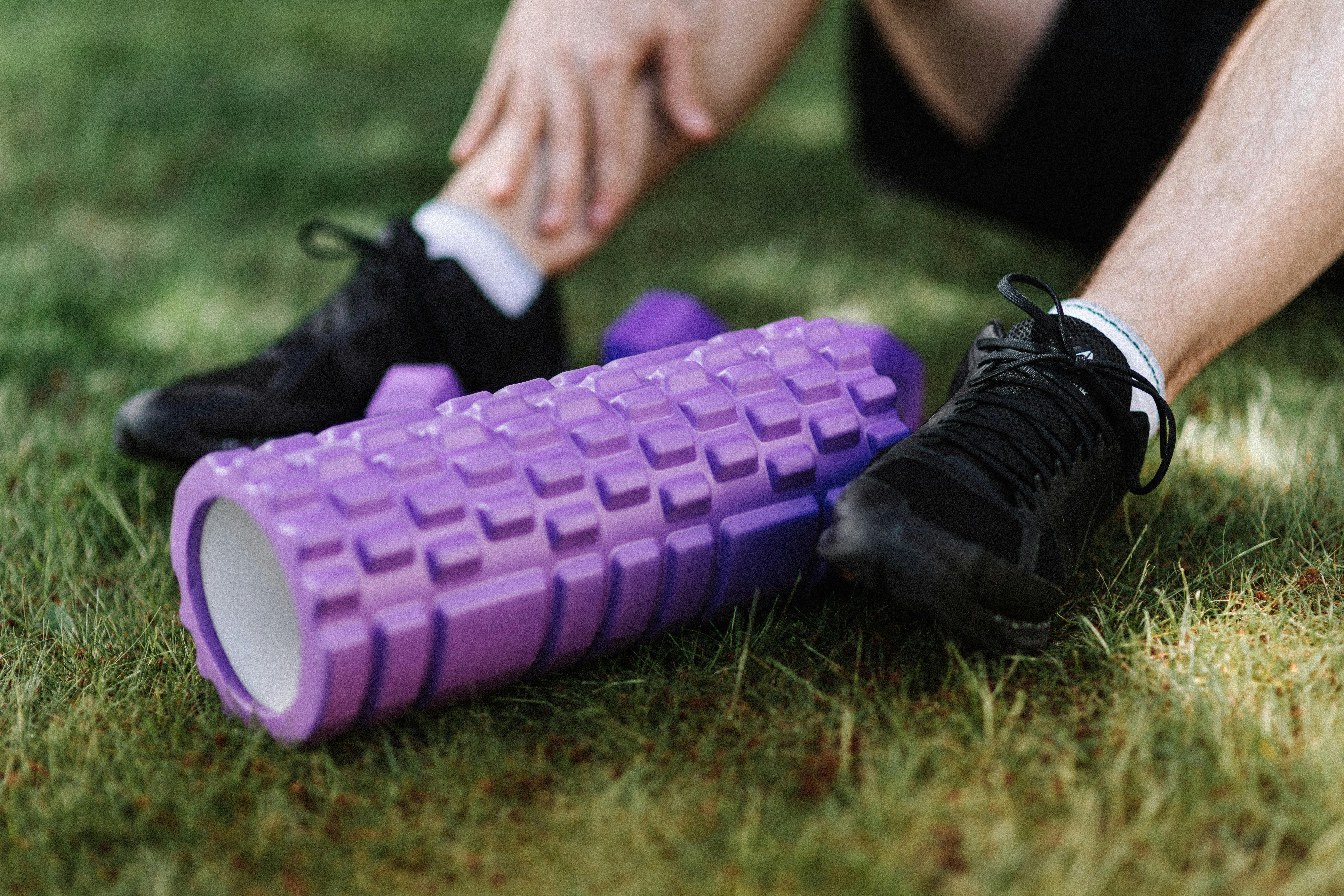
Foam rolling is a well-established practice in the manual therapy world, having gained popularity since the late 20th century. When used alongside treatment, foam rolling is an excellent complementary tool. Numerous scientific studies support its effectiveness in reducing muscle soreness, improving flexibility, and aiding in muscle recovery and performance (1, 2, 3).
However, foam rolling is not as specific as manual therapy, and skilled therapists have a unique ability to identify knots, adhesions, and other muscle conditions that cannot be found with a roller. Therefore, using a foam roller between massages may help maintain therapeutic changes and promote faster improvements than with massage alone.
Foam Rolling Techniques
Bottom of Foot with Foam Roller
A foam roller is a great tool to use at the beginning if a massage ball is unavailable or is too intense. The larger diameter of the foam roller works the muscles and connective tissue closer to the surface of the skin, instead of working deep. With many foot conditions, the goal may be to increase blood flow and not address deep tissue. A regular foam roller can accomplish this purpose and is likely to provide a quick reduction of discomfort.
- Begin by placing the foam roller on a smooth surface (Standing or sitting).
- Place your foot over the foam roller, with the roller just behind the ball of your foot.
- Slowly roll your foot forward about one inch (2.5 cm) per second, so the foam roller is rolling toward your heel (see figure 1.a) (You should stop and hold pressure on it for about 30 seconds or until the tenderness reduce if you feel a tender spot).
- Slowly roll back the other way. Repeat the process back and forth about four times.
- After the fourth roll, position the foam roller near your toe (the starting position) and perform four pivot motions of your foot by simply twisting your foot side to side two times (see figure 1.b).

Figure 1
Posterior Lower Leg with Foam Roller
Unlike the foot, it is more challenging to control the amount of pressure on the roller when foam rolling the calves. Therefore, it is suggested to begin with a larger, softer roller and progress to something harder over time. Using a foam roller on the lower leg will target all of the muscles mentioned in this section. While the compression from the regular foam roller will help the surface muscles more, all of the muscles in the calf region will experience the benefits.
- Begin by sitting on a comfortable surface.
- Place one of your legs on the roller, with the roller positioned just above the ankle.
- Keep your feet relaxed as you roll. Your hands should be positioned slightly behind your hips with your fingers pointed away from your body. To roll, you will need to lift your hips off the floor enough so you can move your body forward.
- Raise your hips and begin to slowly roll forward about one inch (2.5 cm) per second (see figure 2.a) (Stop and hold for about 30 seconds if you feel a tender spot).
- After the tenderness is reduced, slowly roll up and down the muscle about four times.
- Then, position the roller near the centre of your lower leg and perform four side-to-side motions of the leg (see figure 2b).

Figure 2
Outside Lower Leg Exercise
To target the muscles on the outside of the lower leg, choose the size of foam roller that suits you best. The muscles you will target with this exercise are not as thick as the calf muscles, but it is also harder to achieve the same amount of pressure that you could achieve on the calves. It is important to address the entire outside of the lower leg. If you have chronic ankle sprains or even knee pain, you will benefit from rolling these muscles because it reduces tension and restores normal movement in the ankle and knee.
- Begin by sitting on a comfortable surface. The leg to be rolled should be placed in front of you, with your hip rotated out so the outside of your leg can be flat on the ground.
- Place your leg on top of the roller and position the roller near your ankle.
- Slowly begin rolling by moving your leg down a few inches or centimetres (see figure 3a). If you find a tender spot, hold pressure for about 30 seconds.
- Work this area just three to four inches (7.6 to 10.2 cm) at a time.
- Roll each section about four times, moving one inch (2.5 cm) per second.
- After rolling this section four times, perform cross-frictions by moving your leg side to side over the roller (see figure 3b). In a cross-friction, the roller will grip your clothing or skin and create a shearing force in the area.

Figure 3
References
- Fleckenstein, Johannes, Jan Wilke, Lutz Vogt, and Winfried Banzer. 2017. “Preventive and Regenerative Foam Rolling Are Equally Effective in Reducing Fatigue-Related Impairments of Muscle Function Following Exercise.” Journal of Sports Science and Medicine 16 (4): 474-79.
- MacDonald, Graham Z., Duane C. Button, Eric J. Drinkwater, and David George Behm. 2014. “Foam Rolling as a Recovery Tool After an Intense Bout of Physical Activity.” Medicine & Science in Sports & Exercise 46 (1): 131-42. https://doi.org/10.1249/MSS.0b013e3182a123db.
- Naderi, Aynollah, Mohammad Hossein Rezvani, and Hans Degens. 2020. “Foam Rolling and Muscle and Joint Proprioception After Exercise-Induced Muscle Damage.” Journal of Athletic Training 55 (1): 58-64. https://doi.org/10.4085/1062-6050-459-18.
Header Photo by Pexels

Adapted from:
Complete Guide to Foam Rolling
Kyle Stull