


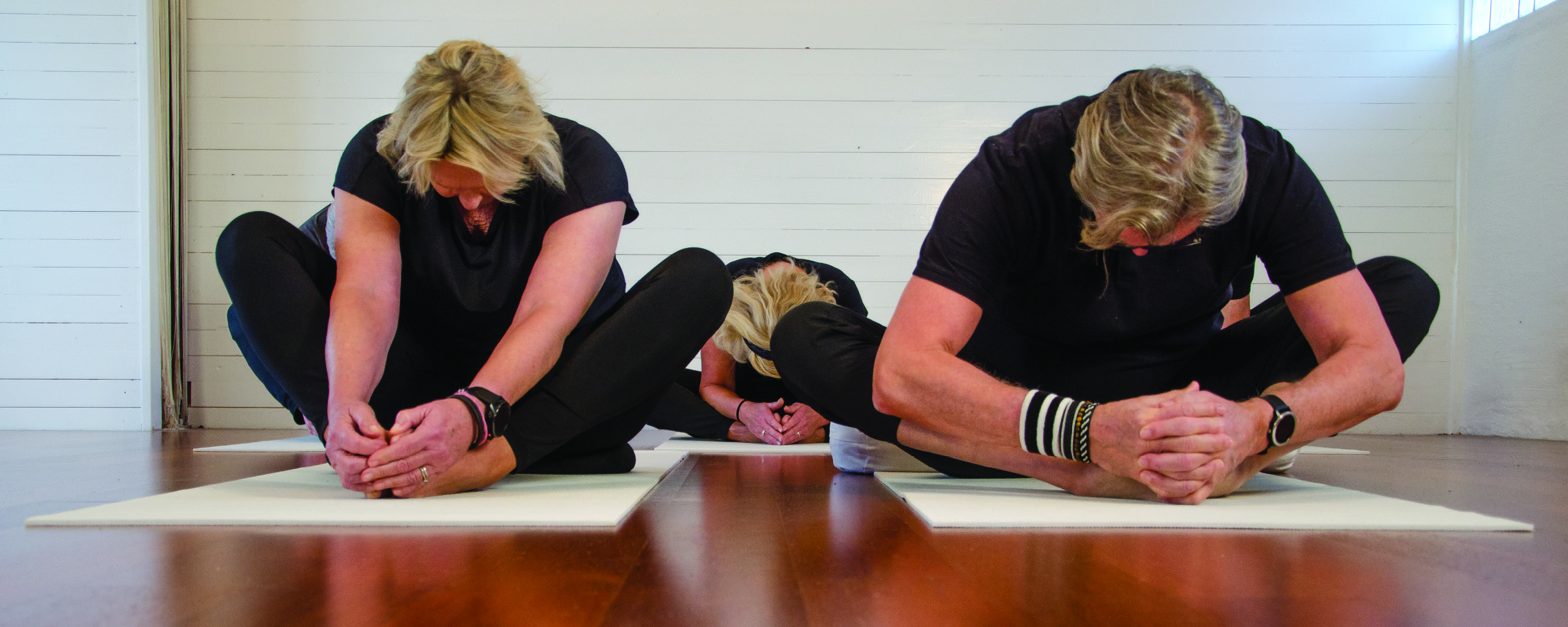
Why write a book about yin yoga for people over the age of 50? The answer is simple. Yin yoga helps us become more flexible, less tense, and enjoy a good night’s sleep. Who doesn’t want to feel those benefits as we get older?
Getting Old Can Be a Pain – Yin Yoga Can Help Us Be Pain-Free
The soft, slow stretches of yin yoga are excellent for stretching and strengthening our connective tissues: our ligaments and tendons, and our muscles. There was a time when my arthritic knee was unresponsive to treatment, including cortisone injections, physiotherapy, and even blood plasma injections. A replacement was looming large. Having practiced yin yoga for a few weeks, I noticed a significant improvement. My knees, ankles, hips, hamstrings, and shoulders were all experiencing improvements in range of motion.
The benefits stretched beyond the physical mind. My resting pulse was much slower, and the deep breathing techniques were making me feel more at peace with myself, helping reduce stress.
What Is Yin Yoga?
Yin yoga is a passive form of yoga where we hold stretches or poses for longer, allowing us to get deeper into our bodies. Yin yoga is nothing new. It’s a Western take on ideas about yoga and meditation that have been around for thousands of years.
The practice of yin yoga involves three elements:
- Finding your edge: Try to find that “Goldilocks moment” where we apply just enough stress in the poses we are holding. Not too little and not too much.
- Finding stillness: By staying still in the pose we let our bodies stretch out over time, meaning we get the full benefit of what we are doing. Try to relax in the pose and let gravity do its work.
- Finding time: The recommended time to hold a yin yoga pose is from three minutes upward. The benefit is obvious, the longer you hold, the deeper the stretch. The more you stretch, the more your connective tissues can “give.” The more they give, the better you feel, as your body pulls itself back into shape.
There are similarities between yin yoga and the treatments prescribed by physiotherapists. The difference is that our “time under tension” may be even longer, stressing and strengthening our connective tissues. The improvement of our range of motion and flexibility will reduce the aches and pains of aging.
How to Start Practicing Yin Yoga
While you should always consult your doctor before practicing yin yoga, it is generally considered safe. You’ll find all poses in the book, yin yoga 50+, as well as ideas for sequences to help you with back pain, sore shoulders, and even for skiers, hikers and golfers. There’s also a section on 15-minute fixes that give you the poses you need to start your day, soothe your shoulders, boost your back, or even help you sleep.
A Fifteen-Minute Fix to Start Your Day
Pose 1: Reclining Butterfly (Two to three minutes)

Couple your hands behind your head, drag your feet up so they are flat, then put the soles of your feet together and let your legs flop. After a while you’ll feel the benefit in your hips.
Pose 2: Child’s Pose (Three minutes)

Flip onto your stomach then come up onto your knees and palms before pushing your hips back. Keep your knees apart and your feet together. Breathe and enjoy.
Pose 3: Cat Pulling its Tail (Two minutes each side)

Pull your hip flexors a bit to wake them up. Prop yourself up on your right elbow. Slide your left leg over your right leg and grab hold of your foot. Pull your foot until you feel the stretch in the top of your hips. After a couple of minutes let go and switch to the other side.
Pose 4: Pull Your Knees to Your Stomach (Three minutes)

Grab hold of your knees and pull them to your chest. You can also pull one leg at a time into your chest to give your stomach muscles a workout.

Adapted from:
Yin Yoga 50+
Paul Steele